How to Become a Professional Engineer in the USA: FE, EIT/EI, PE Exam and License Steps

Earning the Professional Engineer (P.E.) designation is the highest standard of professional recognition in U.S. engineering. Only licensed P.E.s can sign and seal engineering documents, offer engineering services directly to the public, and take legal responsibility for engineering work.
The path from engineering student to licensed P.E. typically takes 8 to 12 years including your degree, and involves a specific sequence of milestones: education, the FE Exam, EIT/EI certification, qualifying experience, the PE Exam, and state licensure. This guide covers every step.
Official-source review
This educational resource was checked against publicly available regulator and examination-board guidance. Rules can change, so confirm the current requirements on the linked official pages before applying, paying or travelling.
What a Professional Engineer Is
A Professional Engineer (P.E.) is an engineer who has been licensed by a state board to practise engineering. The P.E. designation carries legal authority — only licensed P.E.s can sign off on engineering plans, submit official engineering reports, and take professional responsibility for designs that affect public safety.
The P.E. license is issued by individual states, not by a federal body. Each state has its own requirements, though most follow the model rules published by NCEES.
Why P.E. Licensure Matters
P.E. licensure is legally required for engineers who stamp or seal drawings and calculations, offer engineering services directly to the public, or hold final responsibility for engineering projects that affect public safety, health, or welfare.
Beyond legal requirements, the P.E. designation carries significant career advantages: higher salary potential (P.E.s earn 10-20% more on average), greater job security, eligibility for leadership roles, and professional credibility with clients and regulators.
Education Requirements (ABET)
The standard education requirement is a four-year engineering degree from an EAC/ABET-accredited programme. Most state boards require this as the baseline, though some accept related degrees with additional experience.
Some states have graduated experience requirements based on education: ABET graduates typically need 4 years of experience, while non-ABET graduates or engineering technology graduates may need 6-8 years. A graduate degree can sometimes reduce the experience requirement.
Step 1 — FE Exam
The Fundamentals of Engineering (FE) Exam is a computer-based, 110-question test administered by NCEES. It tests broad undergraduate engineering fundamentals across one of seven discipline-specific versions.
Most candidates take the FE Exam during their senior year of college or shortly after graduation. The exam fee is $225, and results are reported as pass/fail within 7-10 business days.
Step 2 — EIT/EI Certification
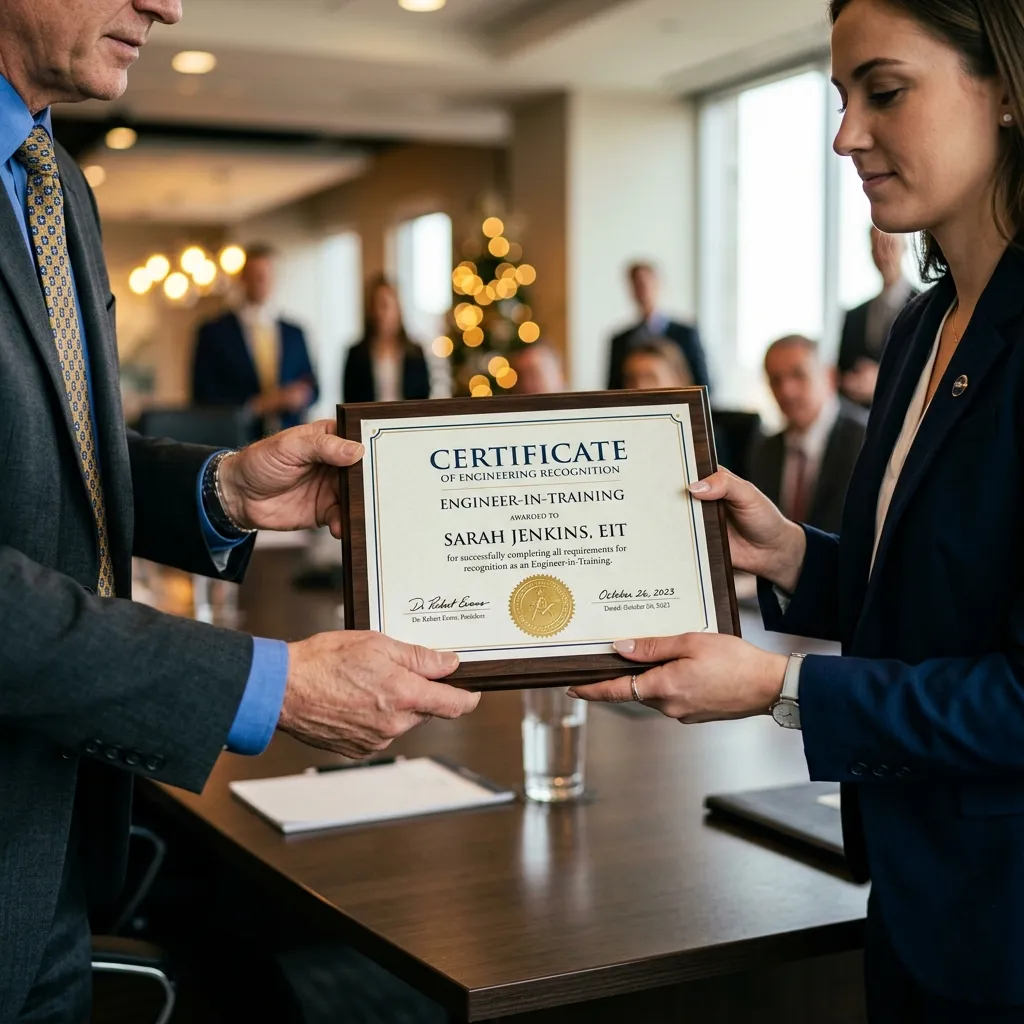
After passing the FE Exam, you apply to your state board for Engineer-in-Training (EIT) or Engineering Intern (EI) status. This is a formal designation — not a license — that confirms you are on the licensure pathway.
Some states grant EIT/EI automatically upon FE passage; others require a separate application. The designation allows you to use the EIT or EI title after your name.
Step 3 — Engineering Experience (4+ Years)
This is typically the longest phase. Most states require a minimum of four years of qualifying, progressive engineering experience after earning your degree. The experience must be supervised or verified by a licensed P.E.
Qualifying experience means engineering work of increasing complexity and responsibility. Design, analysis, project management, construction oversight, and engineering research all typically qualify. Pure sales, marketing, or administrative work generally does not count.
Document your experience carefully from day one. Most states require detailed descriptions of projects, your specific engineering contributions, and verification from a licensed P.E. supervisor.
Step 4 — PE Exam
The Principles and Practice of Engineering (PE) Exam is the second and final NCEES exam. Unlike the FE, which tests fundamentals, the PE Exam tests discipline-specific advanced practice. Most PE Exams are 8 hours with 80 questions.
The PE Exam is offered in numerous disciplines including Civil (with sub-disciplines), Mechanical, Electrical and Computer, Chemical, Environmental, Structural (16-hour exam), and many more. The exam fee is $375.
Step 5 — State Licensure Application
After passing the PE Exam, you submit a licensure application to your state board. This typically includes your PE Exam results, documentation of qualifying experience, professional references (usually 3-5 licensed P.E.s), and payment of licensure fees.
Processing time varies from 2 to 12 weeks. Once approved, you receive your P.E. license number and can legally use the Professional Engineer title and seal engineering documents.
Need support with this certification?
Connect with our admissions office immediately.
The Complete Timeline
The typical total time from starting your engineering degree to receiving your P.E. license is 8 to 9 years. Some candidates complete it faster; others take longer due to career changes, state transfers, or exam retakes.
| Milestone | Typical Duration | Cumulative Time |
|---|---|---|
| Bachelor's degree (ABET) | 4 years | 4 years |
| FE Exam | Senior year or post-graduation | 4 years |
| EIT/EI certification | 2-8 weeks after FE passage | 4 years |
| Qualifying experience | 4+ years | 8 years |
| PE Exam | During or after experience period | 8 years |
| State licensure application | 2-12 weeks after PE passage | 8-9 years |
Cost Breakdown Across the Entire Pathway
| Expense | Cost Range | When |
|---|---|---|
| Engineering degree (4 years) | Varies widely | Years 1-4 |
| FE Exam (NCEES fee) | $225 | Year 4 |
| EIT/EI application | $0 - $100 | Year 4 |
| PE Exam (NCEES fee) | $375 | Year 8 |
| State licensure application | $50 - $300 | Year 8 |
| Study materials (FE + PE) | $100 - $1,000 | Ongoing |
| Credential evaluation (international only) | $200 - $500 | If applicable |
| Total (excluding degree) | $750 - $2,500 | — |
International Engineer Considerations
International engineers follow the same pathway but with additional requirements: credential evaluation of their foreign engineering degree, potentially longer processing times for state board approvals, and SSN/ITIN requirements for some state boards.
The good news is that most states accept foreign engineering degrees after evaluation, and foreign work experience typically counts toward the four-year experience requirement (with proper documentation).
Career Benefits of PE Licensure
Licensed P.E.s earn 10-20% higher salaries on average compared to unlicensed engineers in similar roles. They have access to leadership positions that require a P.E., including principal engineer, project engineer of record, and engineering management roles.
P.E. licensure also provides professional mobility — you can transfer your license to other states through comity, and the credential is recognised and respected worldwide. For engineers in consulting, infrastructure, and public works, the P.E. is not optional — it is the industry standard.
Official baseline for How to Become a Professional Engineer in USA: FE, EIT/EI, PE Exam and License Steps
US engineering licensure is governed by state licensing boards, NCEES and ABET. That body controls education and experience approval at board level, national FE and PE examinations through NCEES, and programme accreditation through ABET. A tutor, recruiter or advisory service can explain the process and help a candidate prepare, but it cannot grant eligibility, change an official result, reserve a regulatory decision or issue a professional licence. For How to Become a Professional Engineer in USA: FE, EIT/EI, PE Exam and License Steps, this distinction is the starting point because it separates useful preparation from a promise no private company has authority to make.
A foreign or non-EAC/ABET degree may need an NCEES Credentials Evaluation, but candidates should wait for direction from the chosen board before purchasing one. The PE exam tests minimum competence in a discipline and is generally intended for engineers with qualifying professional experience; the amount and timing of experience depend on the board. For How to Become a Professional Engineer in USA: FE, EIT/EI, PE Exam and License Steps, read those rules as connected dependencies rather than isolated facts. A change at the eligibility stage can move the booking date, which can change document validity, travel plans and the date on which a registration application becomes possible. The safest plan records each dependency and names the official page that supports it.
For How to Become a Professional Engineer in USA: FE, EIT/EI, PE Exam and License Steps, this research was checked on 28 August 2026 against NCEES examinations and NCEES PE examination. Rules that involve fees, dates, delivery locations, attempts or accepted evidence can change during a candidate's preparation period. Save the page and the access date in your planning file, then check it again before payment and again before travel. A search snippet or an old course handout is not strong enough evidence for a high-stakes decision.
Build the pathway as a chain of gates
The How to Become a Professional Engineer in USA: FE, EIT/EI, PE Exam and License Steps pathway is easier to manage when every step has an input, an owner and evidence of completion. Start with education recognition, then place language evidence, credential verification, assessment eligibility, booking, results and registration in the order required by the official body. Do not use a generic timeline until those dependencies are confirmed. Two candidates pursuing the same exam can have different start dates because one degree needs verification or one regulator requires pre-approval.
Decoupled jurisdictions may allow the PE exam before the experience requirement is complete, but passing early does not waive the later licensing requirements. Engineering licensure is state-based. NCEES develops and scores the FE and PE exams, but a licensing board determines eligibility and grants the credential. For How to Become a Professional Engineer in USA: FE, EIT/EI, PE Exam and License Steps, put each rule into a tracker with four columns: action, official owner, proof of completion and expiry date. The expiry column catches avoidable failures such as language evidence ageing out before registration or an exam authorisation ending before a suitable appointment is available.
Add a stop condition to every How to Become a Professional Engineer in USA: FE, EIT/EI, PE Exam and License Steps gate. If the qualification is not recognised, if an official response is pending or if a required document cannot be obtained, pause spending on later stages. Preparation can continue where it remains useful, but flights, non-refundable bookings and paid verification services should follow confirmed eligibility rather than optimism.
The evidence file that saves weeks later
Create one folder for How to Become a Professional Engineer in USA: FE, EIT/EI, PE Exam and License Steps with subfolders for identity, education, registration, English, examination and correspondence. Use filenames that include the document type and date. Keep the original-language document beside its certified translation, and record who sent an official transcript or verification request. This is basic administration, but it prevents a missing page or mismatched name from becoming an expensive delay near a booking deadline.
The working checklist for How to Become a Professional Engineer in USA: FE, EIT/EI, PE Exam and License Steps is specific: treat examination approval and licence approval as separate gates; choose the licensing jurisdiction before choosing an application process; verify the exact programme and graduation year in ABET's search. After those are complete, ask the board whether an NCEES education evaluation is required; download the current exam specification and reference handbook; document progressive experience in the form the board expects. Mark an item complete only when there is evidence, such as a portal status, receipt, verification response or regulator email. A note saying "submitted" is not the same as an accepted document.
For How to Become a Professional Engineer in USA: FE, EIT/EI, PE Exam and License Steps, check identity consistency across the passport, candidate account, degree, transcript and professional registration. If names differ, ask the regulator which linking evidence it accepts before uploading an improvised explanation. Keep unredacted identity files out of shared study drives. Tutors usually need performance data, not passport scans or regulator passwords.
- treat examination approval and licence approval as separate gates
- choose the licensing jurisdiction before choosing an application process
- verify the exact programme and graduation year in ABET's search
- ask the board whether an NCEES education evaluation is required
- download the current exam specification and reference handbook
- document progressive experience in the form the board expects
Failure modes that basic summaries miss
The first How to Become a Professional Engineer in USA: FE, EIT/EI, PE Exam and License Steps failure mode is category confusion. Candidates mix up an exam pass, an equivalence certificate, registration and a licence. The FE exam is normally the first examination step. Passing it does not by itself create an EIT or EI credential in every jurisdiction. Write the desired end state in full and work backwards from the body that grants it. That exposes missing stages that a headline such as "pass and work abroad" conceals.
The second How to Become a Professional Engineer in USA: FE, EIT/EI, PE Exam and License Steps failure mode is stale precision. A page repeats a fee, date, pass rate or number of questions after the official body has changed it. ABET accredits programmes rather than whole universities, and EAC and ETAC accreditation can lead to different licensure treatment. This is why the article gives a review date and links the primary source. Use precise numbers only when they help a decision, and recheck them at payment.
The third How to Become a Professional Engineer in USA: FE, EIT/EI, PE Exam and License Steps failure mode is weak readiness evidence. Reading notes and recognising explanations can create confidence without recall under pressure. Use timed mixed work, spoken cases, document dry-runs or calculations with full working, depending on the task. A mock score is useful as a trend, not as a guarantee. The decision to sit should combine recent performance, health, logistics and the cost of an attempt.
A worked planning scenario for How to Become a Professional Engineer in USA: FE, EIT/EI, PE Exam and License Steps
For How to Become a Professional Engineer in USA: FE, EIT/EI, PE Exam and License Steps, consider a hypothetical candidate who wants to act within six months while working clinical shifts. The candidate first checks NCEES examinations and writes down the current eligibility rule. Next comes a timed diagnostic or document audit, depending on the article's goal. Only then does the candidate choose a preparation resource or pay for a service. This order may feel slower for one afternoon, but it removes the much larger risk of preparing for the wrong assessment or missing a prerequisite.
For How to Become a Professional Engineer in USA: FE, EIT/EI, PE Exam and License Steps, the candidate keeps two calendars. The official calendar holds application windows, evidence expiry, result dates and registration deadlines. The study calendar holds weekly outputs and mock assessments. When performance is behind plan, the study calendar changes; the official deadline does not. If the gap becomes unsafe, the candidate moves the sitting rather than buying a promise of a last-minute shortcut.
At the final How to Become a Professional Engineer in USA: FE, EIT/EI, PE Exam and License Steps checkpoint, the candidate can answer five questions without guessing: Who makes the decision? What evidence is still pending? What happens if the result is unsuccessful? Which fees are non-refundable? What is the next lawful step after passing? If any answer is unclear, the next action is an official enquiry, not another commercial purchase.
Questions worth answering before you pay
Before paying for How to Become a Professional Engineer in USA: FE, EIT/EI, PE Exam and License Steps, ask the provider what part of the official process it supports, which public blueprint its teaching follows and what happens if the regulator changes the format. Ask whether access expires, whether feedback is individual, whether a sample is available and which refund terms are binding. Do not accept a pass-rate percentage without the sample size, time period, inclusion rules and a way to verify the result.
For a How to Become a Professional Engineer in USA: FE, EIT/EI, PE Exam and License Steps comparison or review, test each product against the same needs: realistic task format, quality of explanations, feedback on weak areas, accessibility, update policy and total price. Brand popularity is not a learning outcome. A smaller resource that corrects the candidate's measured weakness can be more useful than a large library that repeats material already understood.
For a How to Become a Professional Engineer in USA: FE, EIT/EI, PE Exam and License Steps pathway, ask the regulator about the candidate's facts rather than a hypothetical. State the qualification, country, graduation year, current registration, target professional title and intended jurisdiction. Keep the written response. It will be more valuable than a forum answer from somebody whose route looked similar but depended on different rules.
Primary sources and update discipline
The sources used for the How to Become a Professional Engineer in USA: FE, EIT/EI, PE Exam and License Steps expansion are NCEES examinations, NCEES PE examination, NCEES credentials evaluations, ABET accredited programme search. They were selected because they are controlled by the examination, accreditation or licensing bodies that make the relevant decisions. Commercial comparison pages can help identify products, but they are not the authority for eligibility, attempts, accepted evidence, dates or professional registration.
When two official How to Become a Professional Engineer in USA: FE, EIT/EI, PE Exam and License Steps pages appear to conflict, prefer the page for the exact service and current cycle, then ask the body to clarify. Capture the URL, page title, access date and the rule that affected the plan. Avoid copying long passages into notes because the copied text loses navigation context and can become stale without notice.
A research-backed How to Become a Professional Engineer in USA: FE, EIT/EI, PE Exam and License Steps article should make future verification easier. It should show the reader where a rule came from, which facts are time-sensitive and what remains a personal decision. That is the standard applied here. The article explains the reasoning, but the linked official source remains the final check before a candidate submits, pays, travels or relies on the information professionally.

Dr. Bruno Grindewald, MD, MRCP
Senior Medical Instructor & Lead Clinical Editor
Dr. Bruno Grindewald is a specialist in postgraduate medical training and clinical diagnostics with over two decades of experience preparing international medical graduates for Royal College sittings and licensing examinations worldwide.
Frequently Asked Questions
How long does it take to become a Professional Engineer?
Typically 8-9 years from starting your engineering degree: 4 years for the degree, then 4+ years of qualifying experience. The FE and PE Exams are taken during this period.
Can I become a PE without a degree?
Some states allow licensure without a traditional engineering degree, but they typically require significantly more years of experience (8-20 years depending on the state). An ABET degree remains the standard path.
Do I need both FE and PE Exams?
In most states, yes. The FE Exam is the first step (earning EIT/EI status), and the PE Exam is the final step. A few states have exceptions for candidates with extensive experience.
Is a PE license valid in all 50 states?
No. P.E. licensure is state-specific. However, most states offer comity (reciprocity) that allows you to transfer your license with simplified paperwork.
What is the PE Exam pass rate?
Use the linked official regulator or examination-board page for the current figure or rule.
Can I sign engineering documents without a PE?
No. Only licensed Professional Engineers can sign and seal engineering documents. Using the P.E. title without a license is illegal in all U.S. states.
How much do Professional Engineers earn?
Median salaries for licensed P.E.s range from $85,000 to $130,000+ depending on discipline, experience, and location. P.E.s typically earn 10-20% more than unlicensed engineers.
Do all engineers need a PE license?
No. Many engineers work in industry, manufacturing, technology, and other sectors without PE licensure. However, PE is required for engineers who stamp documents, offer public services, or hold engineering authority.
Can international engineers get a PE license in the USA?
Yes. International engineers must have their credentials evaluated, pass both the FE and PE Exams, and complete qualifying experience. Most states accept foreign engineering degrees after evaluation.
What happens if I fail the PE Exam?
You can retake the PE Exam. NCEES allows re-examination after waiting one testing cycle. Most states do not limit the number of attempts, though some require additional documentation after multiple failures.
Is PE licensure worth it?
For engineers in consulting, infrastructure, public works, and any role that requires engineering authority over public safety, PE licensure is essential. It also provides salary premiums and career advancement opportunities.